Pages

Monday, August 27, 2012

Moon Memories

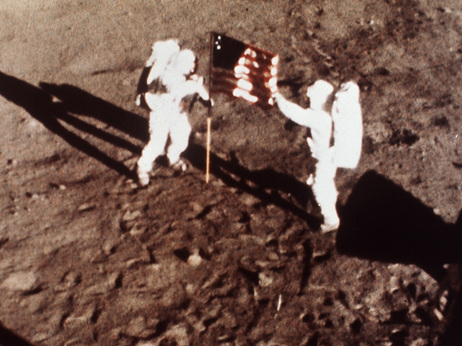
Neil Armstrong, Buzz Aldrin - 7/20/69 - AP/NASA photo

"Houston, Tranquility Base here. The Eagle has landed.”
~ Neil Armstrong, from the Moon's Sea of Tranquility ~ July 20,1969


I was a teenager when Neil Armstrong set the first human foot on the moon’s surface. It was a thrilling moment in modern American history, a time when everything seemed possible. Right before our eyes, even the moon was within reach

The moon landing was, in the jargon of the time, “a happening.” Just about everyone my age saw the first moonwalk on live television. I vividly remember watching with my father, asking a variety of questions that he patiently answered. As the astronauts bounced like paper dolls, moving in slow motion across the moon’s surface, Dad explained the different gravitational force on the moon. It was like witnessing science fiction made fact.

Neil Armstrong was a unique hero. He shunned the celebrity spotlight and lived quietly. In 1970, just one year after walking on the moon, Armstrong left the astronaut program to teach college engineering. He lived out his retirement on a farm in his native Ohio.
 
With the passing of Neil Armstrong, the Eagle has flown. Will America ever soar to such literal and figurative heights again? It doesn’t seem likely, at least at the moment. There aren’t many true American heroes left to us, and the few remaining become ever more precious.

Sunday, August 26, 2012

The Vanishing Present


I received this in an e-mail, and it makes a lot of sense to me (to my regret):

"9 Things Which Will Disappear in Our Lifetime Believe it or not, the following nine things will disappear in our lifetime.  Whether these changes are good or bad depends in part on how we adapt to them. But, ready or not, here they come: 

1. The Post Office Get ready to imagine a world without the post office. They are so deeply in financial trouble that there is probably no way to sustain it long term.  Email, Fed Ex, and UPS have just about wiped out the minimum revenue needed to keep the post office alive. Most of your mail every day is junk mail and bills.
2. The Cheque  Britain is already laying the groundwork to do away with cheque by 2018. It costs the financial system billions of dollars a year to process cheques. Plastic cards and online transactions will lead to the eventual demise of the cheque. This plays right into the death of the post office. If you never paid your bills by mail and never received them by mail, the post office would absolutely go out of business.
3. The Newspaper  The younger generation simply doesn't read the newspaper. They certainly don't subscribe to a daily delivered print edition. That may go the way of the milkman and the laundry man. As for reading the paper online, get ready to pay for it. The rise in mobile Internet devices and e-readers has caused all the newspaper and magazine publishers to form an alliance. They have met with Apple, Amazon, and the major cell phone companies to develop a model for paid subscription services.
4. The Book  You say you will never give up the physical book that you hold in your hand and turn the literal pages. I said the same thing about downloading music from iTunes. I wanted my hard copy CD. But I quickly changed my mind when I discovered that I could get albums for half the price without ever leaving home to get the latest music. The same thing will happen with books. You can browse a bookstore online and even read a preview chapter before you buy. And the price is less than half that of a real book. And think of the convenience! Once you start flicking your fingers on the screen instead of the book, you find that you are lost in the story, can't wait to see what happens next, and you forget that you're holding a gadget instead of a book.
5. The Land Line Telephone Unless you have a large family and make a lot of local calls, you don't need it anymore. Most people keep it simply because they've always had it. But you are paying double charges for that extra service. All the cell phone companies will let you call customers using the same cell provider for no charge against your minutes
6. Music  This is one of the saddest parts of the change story. The music industry is dying a slow death. Not just because of illegal downloading. It's the lack of innovative new music being given a chance to get to the people who would like to hear it. Greed and corruption is the problem. The record labels and the radio conglomerates are simply self-destructing. Over 40% of the music purchased today is "catalogue items," meaning traditional music that the public is familiar with. Older established artists. This is also true on the live concert circuit. To explore this fascinating and disturbing topic further, check out the book, "Appetite for Self-Destruction" by Steve Knopper, and the video documentary, "Before the Music Dies."
7. Television Revenues to the networks are down dramatically. Not just because of the economy. People are watching TV and movies streamed from their computers. And they're playing games and doing lots of other things that take up the time that used to be spent watching TV. Prime time shows have degenerated down to lower than the lowest common denominator. Cable rates are skyrocketing and commercials run about every 4 minutes and 30 seconds. I say good riddance to most of it. It's time for the cable companies to be put out of our misery. Let the people choose what they want to watch online and through Netflix.
8. The "Things" That You Own Many of the very possessions that we used to own are still in our lives, but we may not actually own them in the future. They may simply reside in "the cloud." Today your computer has a hard drive and you store your pictures, music, movies, and documents. Your software is on a CD or DVD, and you can always re-install it if need be. But all of that is changing. Apple, Microsoft, and Google are all finishing up their latest "cloud services." That means that when you turn on a computer, the Internet will be built into the operating system. So, Windows, Google, and the Mac OS will be tied straight into the Internet. If you click an icon, it will open something in the Internet cloud. If you save something, it will be saved to the cloud. And you may pay a monthly subscription fee to the cloud provider. In this virtual world, you can access your music or your books, or your whatever from any laptop or handheld device. That's the good news. But, will you actually own any of this "stuff" or will it all be able to disappear at any moment in a big "Poof?" Will most of the things in our lives be disposable and whimsical? It makes you want to run to the closet and pull out that photo album, grab a book from the shelf, or open up a CD case and pull out the insert.
9. Privacy  If there ever was a concept that we can look back on nostalgically, it would be privacy. That's gone. It's been gone for a long time anyway. There are cameras on the street, in most of the buildings, and even built into your computer and cell phone. But you can be sure that 24/7, "They" know who you are and where you are, right down to the GPS coordinates, and the Google Street View. If you buy something, your habit is put into a zillion profiles, and your ads will change to reflect those habits. "They" will try to get you to buy something else. Again and again."

Saturday, August 18, 2012

Must-See Movie

I'm planning to see 2016: Obama's America this week. It's a movie I think every American voter should watch before Election Day.

Academy Award-winner Gerald Molen and NY Times best-selling author Dinesh D'Souza have collaborated on this film project, something that I consider more than a public service. The movie is a call for American citizens to understand and rise to the challenge of the coming election.

Where will America be in 2016? The voters must decide in November. This film provides the voters with greater access to facts that have been hidden and ignored and gives them a better opportunity to make an informed decision.

Monday, August 13, 2012

A Hope for Change

Although I had hoped he would, I didn't think Mitt Romney would have the guts to pick seven-term Wisconsin congressman Paul Ryan, Chairman of the House Budget Committee, as his running mate.

I've been watching and listening to Paul Ryan over the past year. When it comes to the frightening state of our national finances, Ryan knows the numbers inside and out. The more I've listened to him, the more aware I've become that he knows what he's doing.

Come November, maybe hope and change will at last become possible.

Friday, August 10, 2012

A Voice for Voters

I once heard a commentator remark that when Peggy Noonan is on her game, her words are worthy of being chiseled in marble. Today is one of those days.

"A Nation That Believes Nothing" sums up the weariness of the American citizenry, the voters' disappointment with the presidential race's lack of focus on critical issues, and the immediate dangers in our path--specifically, the ripple effect of the California fiscal crisis.

I don't know how many Americans Peggy Noonan is speaking for today, but I'm sure the number is impressive. And I am certainly one of them.

Thursday, August 02, 2012

Standing for the First Amendment

Amendment I

Congress shall make no law respecting an establishment of religion, or prohibiting the free exercise thereof; or abridging the freedom of speech, or of the press; or the right of the people peaceably to assemble, and to petition the Government for a redress of grievances.


On the spur of the momet, I stopped by the Chick-fil-A near my office last night on the way home from work. When I saw the long line of customers and the growing traffic jam, I decided to join the crowd.

I stepped into line at 5:00 p.m., and I left with mypackaged order at 6:45 p.m. With the possible exception of a Disneyland attraction many years ago, I’ve never stood in line for that much time.

The media is insisting this “controvery” is about gaymarriage. Isn’t it astonishing, that we’ve reached the point where a business leader who states that he believes that marriage is between a man and a woman becomes a controversial figure? But here we are. Chick-fil-A is being run out of Boston
and Chicago because the owner has a different opinion than the PC Thought Police.

"Chick-fil-A Appreciation Day” was not about gay marriage, or conservative Christians, or hate, or bigotry. This was about the fight to protect the First Amendment.

Since the USA’s founding, uncounted thousands of Americans have fought, bled, and died to protect and defend our rights and liberty. A couple of hours in line—followed by a delicious chicken sandwich and fries—was the least I could do in their honor.

Lee Habeeb put it best: "It is simply un-American to put a guy out of business for not agreeing with you."

Sunday, July 29, 2012

Radio Reading

I'm a conservative talk radio addict, but over the years I've learned that's a good thing. In fact, listening to talk radio, I've learned quite a lot.

One of my favorite features in talk radio is the author interview. I'm a true sucker for these, because I often find myself so intrigued listening to the author that I purchase the book--and find myself learning even more.

Below are three books I've recently completed reading that I recommend to any American voter in this highly charged election season. Long-time readers will recognize the authors' names.

After America: Get Ready for Armageddon, by Mark Steyn

One of my favorite people to listen to, Mark Steyn has earned his link on my sidebar and his place as one of the most quick-witted and entertaining, not to mention insightful, pundits on the political scene today. I hear him almost weekly in his appearances as a recurring guest on Hugh Hewitt's radio show. His prior book, America Alone: The End of the World As We Know It (2006), was a fast and fascinating read that has proved eerily prophetic about our changing global demographics, particularly regarding the consequences of Islamic influence on Western culture.

After America (2011) is a bit more in-depth, a bit more grim in its conclusions pertaining to our nation's future as a global power. But it is delivered with Steyn's trademark wit and flair, and I found myself laughing out loud at several points even as I shivered at his prognostications.

When I first heard Steyn on the radio, I thought he was Australian. As I continued to listen weekly, I learned he was Canadian-born, United Kingdom-educated, and now a resident of New Hampshire. If you haven't yet heard Mark Steyn's unique style, I recommend a visit to YouTube; type in "Mark Steyn" and take your pick of dozens of examples of his speaking. Knowing how he sounds, and his talent for phraseology, will enhance your reading experience.

Ameritopia: The Unmaking of America, by Mark R. Levin

Mark Levin is a take-no-prisoners talk show host, one who is highly intelligent, extremely astute, and completely out of patience with the liberal agenda in America. Don't take my word for it; listen to his show sometime.

Ameritopia (2012) examines in depth such classics as Plato's Republic, Thomas More's Utopia, Thomas Hobbes' Leviathan, and Karl Marx's Communist Manifesto to explain just how much trouble we, as a nation, are mired in. An attorney who served as an advisor in the Reagan administration, Levin makes a compelling case for the dangers of what he calls "post-Constitutional America," which can only lead us to ruin. Ameritopia is a disturbing book, but one that takes hold of the reader and doesn't let go. It teaches us where we came from, where we are now, and--if we are not more careful with our hard-won heritage of freedom--where we are going.

The Brief Against Obama: The Rise, Fall & Epic Fail of the Hope & Change Presidency, by Hugh Hewitt

A practicing attorney and law professor, Hugh Hewitt hosts a nationwide radio talk show each weekday, 3:00-6:00 p.m. Pacific time. In the interest of full disclosure, I'm a loyal listener since 2002 and a subscriber to the "Hughniverse," meaning I receive his podcasts and thus never miss a show. (As I mentioned at the outset, I'm an addict.)

Applying a courtroom approach, Hewitt uses extensive quotations from President Obama to open each of the 25 chapters in The Brief Against Obama (2012). Employing the president's own words, Hewitt then methodically and with legal precision exposes the president's statements as the complete failures they have been. Obamacare, the stimulus bill, green energy, unemployment, "the Fast and Furious" scandal, foreign policy failures--and unfortunately, much more--are all covered in depressing detail.

It's very difficult to dismiss the evidence when the president's own words serve as the preface to Hewitt's carefully documented debacle of shortfalls, broken promises, and outright falsehoods.

While different in background, style, and personalities, these authors all have very important traits in common: they know their subjects well, they are meticulous researchers, they write well, and they back up their writings with facts and sources. The end notes sections of each of the three books listed above are impressive and extensive. Unlike TV network news, nothing was pulled out of thin air.

Most likely, MSM honchos would love to pull these three insightful writers off the air. With solid information such as Steyn, Levin, and Hewitt have provided in these books--in thought-provoking and intelligent ways--good luck with that.

Radio. It's the new, much smarter, TV.

Tuesday, July 24, 2012

Hometown News

It makes me proud that my hometown newspaper, the San Diego Union-Tribune, printed a detailed and scathing indictment of Barack Obama's presidency on their editorial page.

Judging from the comments (241 at last count), "Presidential busts: The worst of all: Barack Obama (2009-?)" is not a going over well with the California liberals. There's that familiar saying about the truth hurting, which certainly applies. But to respond to the umbrage, I prefer the blunt elegance of John Adams, our second president and one of the nation's Founders:

"Facts are stubborn things."

Saturday, July 21, 2012

For Aurora


BY ALFRED, LORD TENNYSON
Discovery Enterprise
Break, break, break,
         On thy cold gray stones, O Sea!
And I would that my tongue could utter
         The thoughts that arise in me.

O, well for the fisherman's boy,
         That he shouts with his sister at play!
O, well for the sailor lad,
         That he sings in his boat on the bay!

And the stately ships go on
         To their haven under the hill;
But O for the touch of a vanish'd hand,
         And the sound of a voice that is still!

Break, break, break
         At the foot of thy crags, O Sea!
But the tender grace of a day that is dead
         Will never come back to me.

Wednesday, July 18, 2012

Dismissing the Dream


“If you’re one of the millions of Americans counted as part of the eight percent unemployed, you didn’t get there on your own. Somebody else made that happen. And he’s running for reelection.”
~    Nick Ryan, Townhall.com


I’ve read a large amount of outraged reactions to President Obama’s ridiculous statement that “If you’ve got a business, you didn’t build that. Somebody else made that happen,” Some commentators are suggesting that perhaps that one unscripted line, which gave America a frightening glimpse into the way this president really thinks, may cost him the election.

From their tweets to God’s ears.

But no one I’ve read has captured the essence of this blatant insult to small business owners the way John Kass of the Chicago Tribune has in today’s article, “Who else, Mr. President?”

Kass writes about his father and his uncle toiling on the small businessman’s treadmill in their little supermarket. He writes with a quiet passion for his father’s hard-earned accomplishments and a seething, understated scorn for this “leader” who doesn’t understand the country he is in the process of strangling.

There are a lot of people like John Kass in the U.S. In fact, I’m one of them. My husband had his own construction business for many years. He worked from dawn to dark, and most years our family barely got by. We never saw a dime of government money. Nor, more importantly, did we ask for or want any.

The president might ask if my husband used the roads. Yes, Mr. President. He drove all over Southern California. And we, the taxpayers, paid for those roads.

The president might ask if he had a good teacher. Yes, Mr. President. Pete had many good teachers in school. But none of them taught him construction. No, he learned how to build on the job, from a European immigrant small-business owner who had come to this country and become wealthy by working hard, taking risks, and living the American dream.

The days when such an achievement is possible are drawing to a rapid close under the confiscatory ways of an ever-expanding monster government. The American dream? The hard work is still part of it. It’s the endless possibilities that are gone.